The Quiet Case for the E-Bike
Every so often an idea turns up somewhere unexpected. This summer, the veteran American environmentalist Bill McKibben used his newsletter to argue that the e-bike, not the electric car, might be the single most transformative invention of our time. We think he's onto something, not least because it's an idea we've built a company around for the past decade.
An idea that got away from him
McKibben has spent forty years writing about the climate, so when a claim slipped out unplanned during a New York Times podcast recording with journalist Ezra Klein, it was worth considering. He caught himself mid-sentence wondering if it was overstating, and spent the following edition of his newsletter, The Crucial Years, trying to work out whether he had. His conclusion, once he'd totted up the numbers, was that he hadn't.
What the numbers say
A bicycle alone is already an efficient way to move, by one widely cited estimate around four times more efficient than walking. Add a motor that assists the pedalling rather than replacing it, and the effect on how cities move is starting to show up clearly in the data. New York's bike-share scheme now carries as many rides in three days as the self-driving taxi operator Waymo manages across all its US cities in a week. In the City of London, cyclists already outnumber cars two to one. Across Paris, they outnumber cars altogether. In Copenhagen, cycling accounts for nearly half of all journeys to work and school. Even in Beijing, a city that spent much of the last thirty years clearing cyclists off its streets to make way for the car, numbers are climbing again as it extends its network of dedicated cycle lanes. China now has an estimated 400 million e-bikes in circulation, and by one 2023 estimate, e-bikes worldwide were already displacing close to a million barrels of oil a day, more than electric cars manage.
Why e-bikes?
None of this explains why e-bikes, rather than ordinary bicycles, are doing most of the work. The answer has less to do with speed than with who gets included. Pedal assist means arriving at your destination without being drenched in sweat. It means a child or a week's shopping stops being a reason not to cycle. It's the same principle behind our own activity level ratings: an e-bike doesn't make a route easier so much as it makes the same route available to more people, riding at whatever pace suits them, alongside each other rather than sorted into separate groups by fitness. Bike-share schemes have found the same thing works in their favour. Chicago's Divvy scheme reports that its e-bikes are ridden 70% more often than its standard bicycles, despite costing considerably more to hire.
The e-bike isn't transformative because it might one day replace the car. It's transformative because it replaces the assumption that seeing somewhere properly, at cycling pace, requires a particular level of fitness or a particular kind of holiday.
This blog draws on reporting and figures first published by Bill McKibben in his newsletter, The Crucial Years (“Tour de Planet”, 11 July 2026). Curious where an e-bike can take you? Explore our destinations or find your next scheduled journey.
Latest Stories
Read all stories-
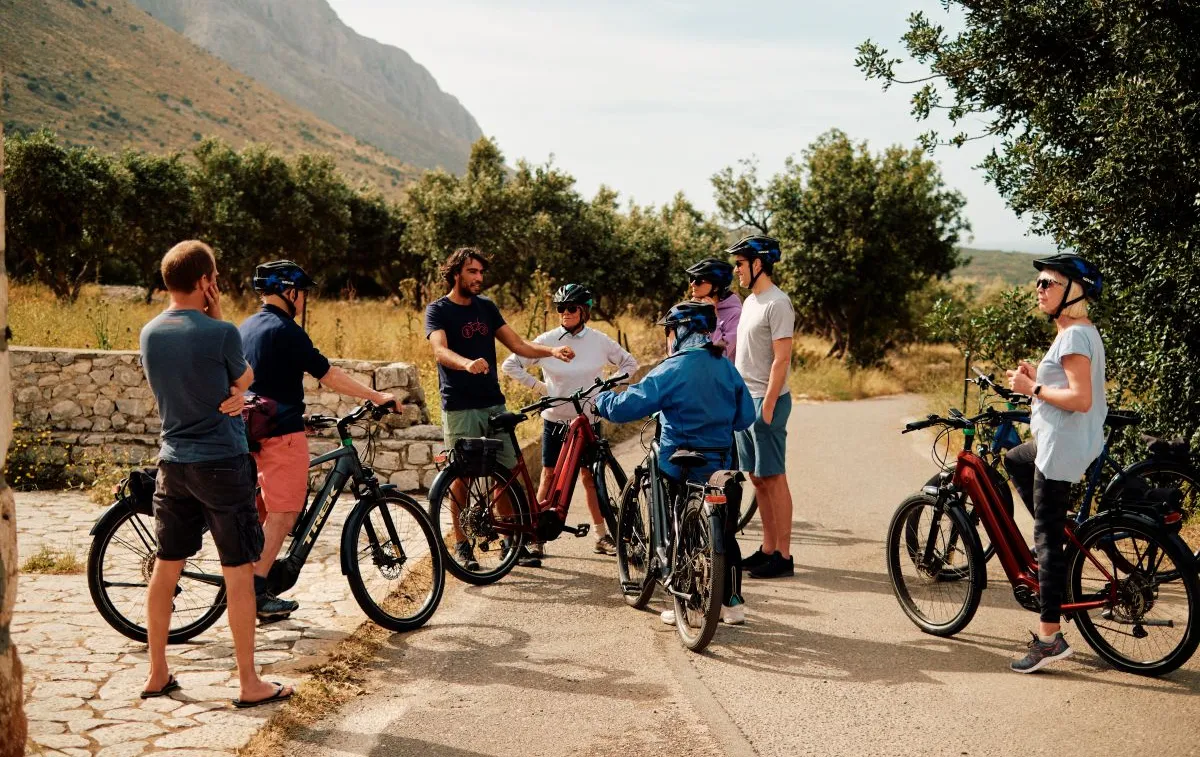
Vangelis: Slow Cyclist Guide in The Mani Peninsula, Greece
-

South Africa FAQS - Everything You Need to Know About Cycling in the Karoo
-

Watch: Our Karoo Webinar with Jaco and Katja
-

The Best Books Written by Adventurers and Explorers
-
Europe by Train: The Best Way to Reach a Slow Cyclist Trip
-

25 Years of Faia Brava Nature Reserve